
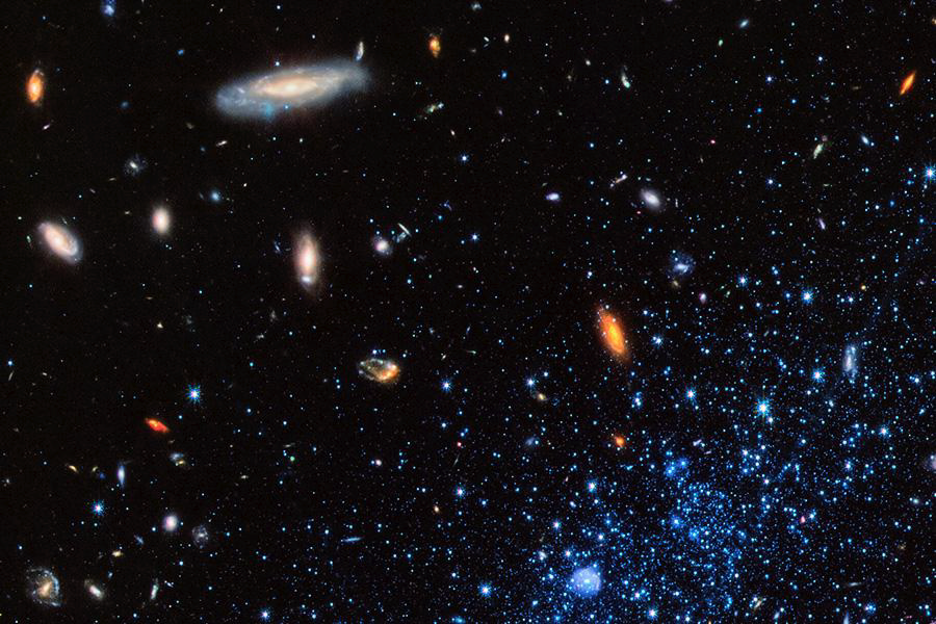
New research focusing on 15 of the most “pristine” small, remote galaxies known enabled measurement of the primordial helium abundance with unprecedented precision. Image credit: NASA
(September 9, 2026) An international team using the Large Binocular Telescope Observatory has reached a major milestone in “precision cosmology” by measuring the amount of helium created in the universe’s first five minutes with unprecedented accuracy.
The series of five papers published in the Astrophysical Journal details how the team was able to leverage 130 hours of observation time on the LBT to reduce the uncertainty of this fundamental cosmic value to just 0.5% – three times better than previous standards. The study’s findings provide new clues about the beginning of the universe and helps researchers better understand the fundamentals of physics. This experiment follows the tradition of testing the Standard Model in physics which, historically, has led to technological breakthroughs.
“This is a physics experiment on a grand scale and one of the biggest findings in my entire 40-year career,” said Evan Skillman, University of Minnesota College of Science and Engineering Distinguished Professor of Physics and Astronomy. “It’s a fundamental number that tells us specifically about the conditions of our universe in its first five minutes. It has diagnostic power that speaks directly to the Standard Model of Physics.”The Big Bang Theory shows how the universe expanded from an extremely high-density and high-temperature state approximately 13.8 billion years ago. The theory rests on three pillars: expansion of the universe, cosmic microwave background and the abundance of light elements like helium and deuterium. The last pillar – helium – hasn’t been studied and measured as extensively as the previous two pillars.
To reach this level of precision, the team moved away from traditional extrapolation methods — estimating an unknown value by extending a trend line of known data — which requires measuring many galaxies and estimating the initial helium level. Instead, they focused on 15 of the most “pristine” small, remote galaxies ever discovered. These galaxies are chemically unevolved that they act as “time capsules,” preserved almost exactly as they were shortly after the Big Bang.
Using advanced spectrographs built at The Ohio State University, the researchers analyzed more than 10 helium lines and 15 hydrogen lines simultaneously. This allowed them to account for small systematic effects that were previously deemed negligible but become critical when aiming for sub-percent accuracy.
“The MODS spectrographs took 12 years to build from conception to first light on sky,” said Richard Pogge, College of Arts and Sciences Distinguished Professor of Astronomy at Ohio State University. “This is the kind of project we designed them to do, and to see them deliver is enormously satisfying. It’s not every day you can help build instruments that measure something fundamental about our universe.”
The precise measurement not only confirms history, but provides a precise look at the Standard Model of Physics. By determining the exact amount of helium, the team was able to calculate the number of neutrino families – the lightest subatomic particles – present in the early universe.
“Helium now serves as a finely honed tool that allows us to test the basic hot Big Bang picture – which passes with flying colors,” said Brian Fields, Professor of Astronomy and Physics at the University of Illinois Urbana-Champaign. “Flush with this success, we can turn the problem around and treat the early Universe as an accelerator that probes neutrinos, dark matter, and other new physics with unprecedented clarity.”
The research team responsible for the results includes scientists at the University of Minnesota Twin Cities, The Ohio State University, Gonzaga University, Northwestern University, The University of Texas at Austin, Indiana University, University of California Santa Cruz, University of Illinois, Universidad Nacional Autónoma de México ,and TRIUMF.
References:
Astrophysical Journal Focus Issue
The LBT Yp Project I: An Improved Determination of the Primordial Helium Abundance – Project Description, Sample Selection, Observations, and Methodology
The LBT Yp Project II: MODS Spectra, Physical Conditions, and Oxygen Abundances in Local Metal-Poor Nebulae
The LBT Yp Project III: LUCI Spectra of Metal-Poor Nebulae
The LBT Yp Project IV: A New Value of the Primordial Helium Abundance
The LBT Yp Project V: Cosmological Implications of a New Determination of Primordial 4He
